

MD. Yusuf - Best Brand Consultant in Bangladesh
I’m Md. Yusuf, aka Marketer Yusuf - a Brand Strategist and Visual Storyteller. I help businesses grow through research-driven branding and marketing campaigns that connect, convert, and inspire.
By Md. Yusuf
Brand
February 16, 2026
When we talk about brand marketing or branding, one word almost always comes first-brand positioning.
As a Brand Marketer with 12 years’ experience in Bangladeshi corporate & industrial sectors; in my professional journey, I have seen this term used everywhere, but understood by very few.
Many business leaders ask me the same question:
“Actually, what is brand positioning?”
From my experience, brand positioning is not a textbook theory. It is a practical business tool. It shapes how customers think about your brand when they have multiple choices in front of them.
In Bangladesh, I have worked with local brands, industrial companies, and growing businesses. One common issue I repeatedly see is confusion. Brands spend heavily on advertising, discounts, and visibility, but fail to define what they truly stand for.
In this article, I want to explain brand positioning in a simple and practical way. Everything here is based on real work, real brands, and real market situations in Bangladesh-so business leaders can apply it, not just understand it.
What Is Brand Positioning (From My Experience)?
In my experience, brand positioning means creating a clear and specific place for your brand in the customer’s mind.
Simply put, whatever customers think and feel about your brand-that is your brand positioning.
I have seen many businesses assume that positioning happens automatically. It does not. Positioning must be created intentionally.
Brand positioning is one of the most important parts of brand marketing. Over the years, I have learned that without clear positioning, it is almost impossible to build a strong brand. Positioning becomes the foundation on which every marketing decision stands.
When a brand clearly highlights what makes it different, it becomes easier for customers to remember it. If your brand comes to mind first at the moment of decision, your positioning is working.
Consistent positioning also builds trust. When customers repeatedly see the same message, tone, and promise, loyalty grows naturally.
Beyond the Logo: Defining Modern Brand Positioning in 2026
I often tell business leaders this:
“If you think your brand is your logo, you are building a house on sand.”
In 2026, a logo is only a visual shortcut. Real brand positioning is about owning mental space in the customer’s mind.
From what I have observed, strong brands focus more on perception than appearance. Modern brand positioning is not about how a brand looks. It is about how it is experienced and remembered. A practical example of this can be seen in this case study on Banglalink’s rebranding, where visual change followed a deeper strategic repositioning.
Customers no longer buy products alone. They buy solutions to their problems. In my work, I have seen that brands which position themselves around a clear solution outperform those that only claim to be “the best.”
Earlier, many brands tried to win by saying they were better than competitors. Today, winning brands stand for one clear solution and deliver it consistently.
As Marty Neumeier said:
“A brand is not what you say it is. It’s what they say it is.”
That is why trust plays such a critical role today. Data, research, customer feedback, and market behaviour continuously shape brand positioning.
In Bangladesh, I have noticed that many local brands-especially in clothing, food, and retail-fail because they all look and sound the same. In such markets, positioning often comes down to reliability and honesty.
People do not choose AARONG just because of its logo. They choose it for what it represents-heritage and authenticity. PICKABOO is trusted because it positions itself on genuine products. The logo is secondary. The promise is what people actually buy.
Why CEO’s Must Prioritise Positioning Over Advertising in Bangladesh
I like to explain this with a simple analogy.
Advertising is like renting a house. The moment you stop paying, you lose the roof. Positioning is like buying land. You own it for the long term.
From my experience, advertising is a cost, but positioning is an investment.
I have seen many brands spend heavily on ads without a clear position. In those cases, advertising becomes noise. In 2026, with rising digital advertising costs in Bangladesh, this approach is no longer sustainable.
Many CEOs I meet still believe marketing means offers and discounts. Discounts may increase short-term sales, but over time they weaken the brand and push businesses into price wars.
Strong brand positioning helps brands escape this trap. Offers bring temporary results. Positioning builds long-term business value.
Another common mistake is judging success only by likes, reach, or impressions. Reach without relevance wastes money.
Walton is a strong local example. They do not just run ads. They position themselves as “Global standard, made for Bangladesh.” Without this positioning, their advertising would struggle against global competitors.
How I Approach Creating Strong Brand Positioning
From what I have learned, winning positioning is not about being better. It is about being meaningfully different in a way that matters to the customer.
Every strong brand position balances three core elements. If any one of them is missing, the positioning becomes weak.
The Three Core Pillars of Brand Positioning
1. Target Audience Identification (Who)
The first step I always take is understanding the target customer.
Without a clear audience definition, positioning becomes generic. I focus on building a detailed profile that includes:
- Demographics such as age, location, and income
- Problems they are trying to solve
- Aspirations and desires
- Buying behaviour and decision-making process
- Personal and cultural values
When this clarity is missing, even good marketing fails to connect.
2. Unique Value Proposition (What)
Once the audience is clear, I analyse what the brand truly does better than others.
A Unique Value Proposition is not a long description. It is a clear promise. It should explain:
- The problem the brand solves
- What makes it different from competitors
- The real benefit the customer receives
I always remind teams that features do not create positioning-meaning does.
3. Reason to Believe (Why)
In my experience, customers trust brands that can prove their claims.
Reason to Believe answers one simple question:
Why should customers trust this brand?
This proof can come from:
- Customer reviews and testimonials
- Certifications or quality standards
- Company history and experience
- Consistent performance over time
Without proof, positioning remains just a statement.
Why Consistency Is the Key to Brand Positioning
One thing I have learned over the years is this: brand positioning is not a one-time campaign.
Consistency must be maintained across:
- Messaging: the same core idea everywhere
- Visual identity: logo, colours, fonts, and imagery
- Customer experience: service that reflects the promise
Consistency builds trust. Trust builds loyalty. Loyalty builds strong brands.
Brand positioning is a journey, not a destination.
Brand Positioning vs. Brand Awareness: A Common Confusion in Bangladesh
Many business leaders in Bangladesh assume that if people recognise their logo, branding is complete. In my experience, this is one of the most expensive mistakes brands make.
Brand awareness tells people that you exist.
Brand positioning tells them why they should choose you.
Awareness helps a brand enter consideration. Positioning helps it win the decision.
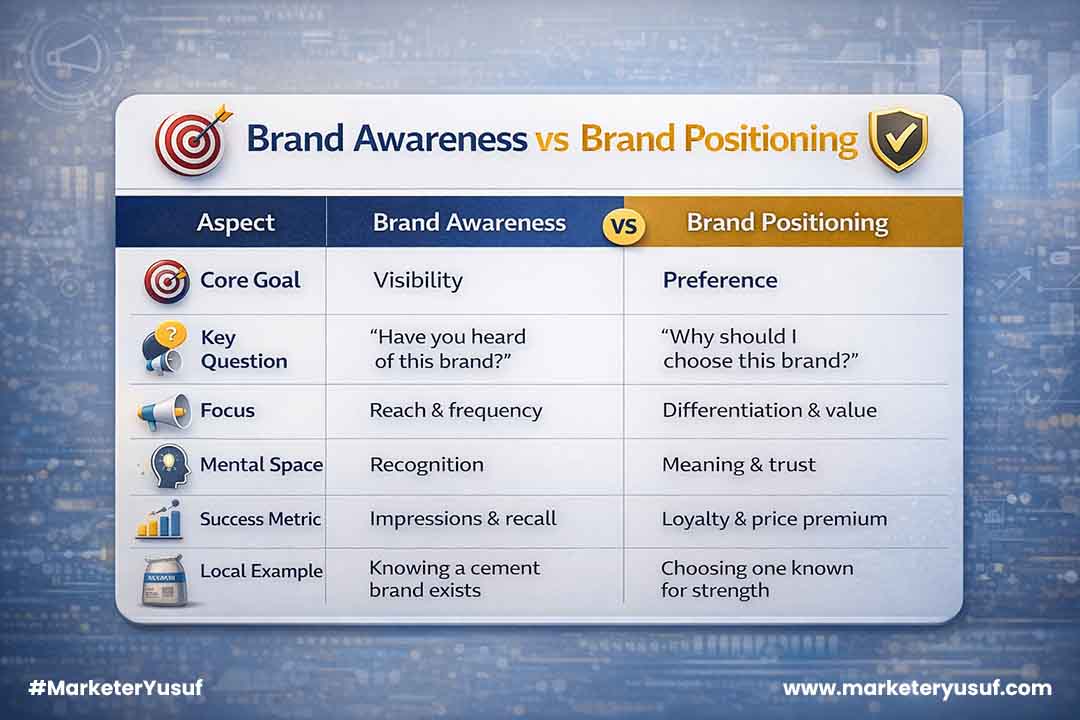
| Aspect | Brand Awareness | Brand Positioning |
| Core Goal | Visibility | Preference |
| Key Question | “Have you heard of this brand?” | “Why should I choose this brand?” |
| Focus | Reach & frequency | Differentiation & value |
| Mental Space | Recognition | Meaning & trust |
| Success Metric | Impressions & recall | Loyalty & price premium |
| Local Example | Knowing a cement brand exists | Choosing one known for strength |
Why Positioning Must Come Before Awareness
From what I have seen, building awareness before defining positioning is a waste of resources.
- Awareness without meaning is a vanity metric
- Positioning gives direction to every marketing effort
- Awareness says, “We are here.” Positioning says, “We are the right choice.”
In today’s competitive Bangladeshi market, brands that define positioning first will always outperform those that focus only on visibility.
Conclusion
From everything I have learned over the years, one thing is clear: brand positioning is no longer optional.
In Bangladesh’s competitive market, visibility alone is not enough. Customers may see your brand, but without clear positioning, they will not choose it.
I have seen brands grow faster when they focused on positioning before advertising. I have also seen brands struggle when they chased awareness without clarity.
Brand positioning is not a campaign. It is a long-term commitment. It requires consistency, honesty, and deep understanding of the customer.
If you want your brand to be remembered, trusted, and chosen-start with positioning. Everything else becomes easier when this foundation is strong.
About Me

Md. Yusuf
Brand Strategist
Md. Yusuf aka Marketer Yusuf is the best brand strategist crafting research-backed branding and growth-driven campaigns.