Brand Identity


MD. Yusuf - Best Brand Consultant in Bangladesh
I’m Md. Yusuf, aka Marketer Yusuf - a Brand Strategist and Visual Storyteller. I help businesses grow through research-driven branding and marketing campaigns that connect, convert, and inspire.
By Md. Yusuf
Brand, Brand Identity
June 5, 2026
The Bangladeshi business landscape in 2026 is no longer just about survival; it is about standing out in a hyper-competitive digital world. While many entrepreneurs focus solely on immediate sales, the most successful market leaders invest in something much deeper: a robust brand identity.
In my previous guide on why brand identity is essential, I discussed how identity acts as the engine for long-term growth. But how do you actually build one from scratch in the local context? Building a brand that resonates from the streets of Motijheel to the digital screens of Gen-Z requires more than just aesthetics. It requires a strategic blueprint.
In this guide, I will share the exact step-by-step process I use to build powerful brand identities in Bangladesh. Drawing from my 12+ years of experience working with leading industrial and retail brands, I’ll show you how to move from a basic logo to a strategic identity system that commands loyalty and leaves a lasting footprint.
How to Build a Winning Brand Identity: Step-by-Step
Building a brand identity in 2026 is no longer about just hiring a graphic designer to create a “cool logo.” In today’s Bangladesh, where digital and physical marketplaces are merging, you need a blueprint that integrates strategy with aesthetics.
A modern brand identity is a living ecosystem. It must be strong enough to provide stability but flexible enough to adapt to changing consumer behaviors. Whether you are launching a corporate industrial venture or a retail startup, the process remains the same: you must build from the inside out.
The following steps are designed to take you through that journey-starting from the invisible strategy to the visible elements that the world will eventually see and trust.
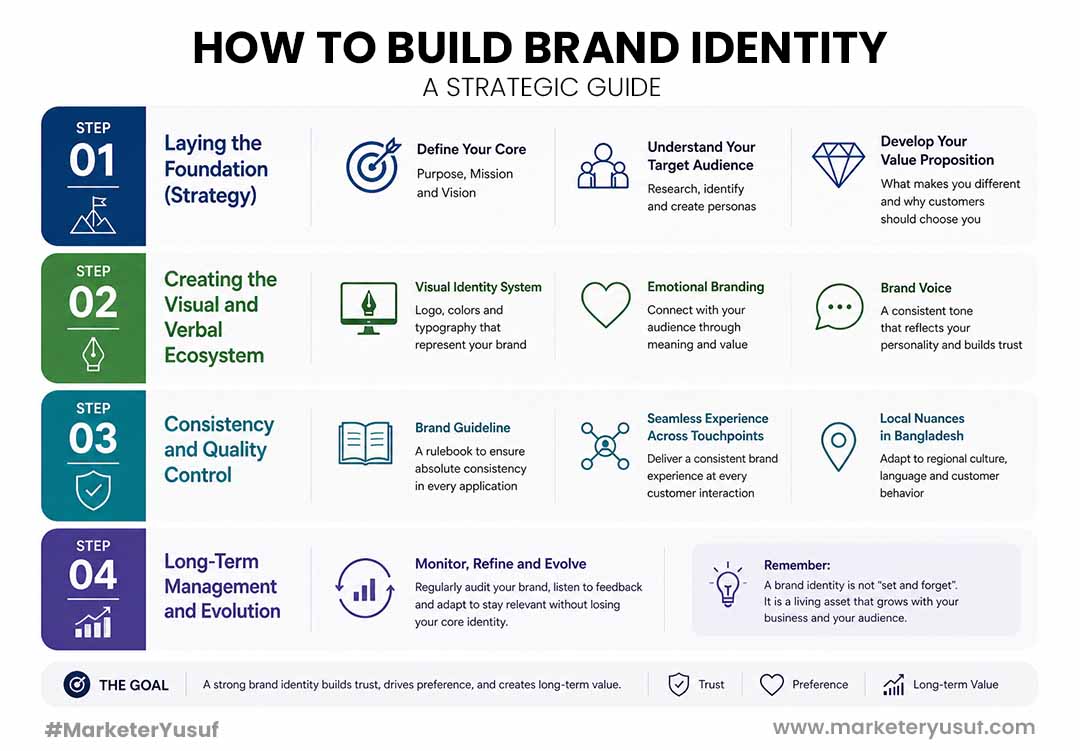
Step 1: Laying the Foundation (Strategy)
Before thinking about colors, logos, or fonts, I always define the core strategy. Without this, your brand will look good but feel empty.
H3: Defining Your Core: Purpose, Mission, and Vision
I call this the Core Identity Triangle.
- Purpose (Why): Why does your business exist beyond profit?
- Mission (What): What do you do every day to achieve that purpose?
- Vision (Where): Where do you want to go in the next 5–10 years?
When these three are clear, everything else—design, messaging, and communication—becomes aligned and powerful.
Understanding the Bangladeshi Target Audience (Know Your Market)
If you don’t deeply understand your audience, your branding will fail—no matter how good it looks. Here’s how I approach it:
- Demographics: Age, location (urban vs. rural), income, and education.
- Psychographics: Values, lifestyle, and emotional triggers.
- Customer Persona: A clear profile of your ideal customer.
In Bangladesh, I’ve noticed that trust, family values, and community influence play a huge role in decision-making-especially in the industrial and retail sectors.
Developing Your Brand’s Value Proposition (What Makes You Different?)
Your Unique Value Proposition (UVP) is your competitive weapon. Ask yourself: Why should a customer choose you over others?
In a crowded Bangladeshi market, being “good” is not enough-you must be:
- Different
- Relevant
- Memorable
If your brand looks like everyone else, you’re actually promoting your competitors.
Step 2: Creating the Visual and Verbal Ecosystem
Once the strategy is clear, I move to what people see and feel-your brand expression.
Crafting Your Visual Identity System (Logo, Colors, Typography)
Your visual identity is your first impression.
- Logo: Simple, scalable, and timeless.
- Color Palette: Emotion-driven (e.g., Blue for trust, Green for growth).
- Typography: Must match your personality and remain readable everywhere.
Pro Tip: I always design with real-life usage in mind-from massive billboards in Motijheel to tiny mobile screens.
Emotional Branding: Connecting Through Meaning
People don’t buy products-they buy feelings and meaning. I always ask:
- Are we selling security?
- Are we selling status?
- Or a solution to daily problems?
In Bangladesh, emotional triggers like family, reliability, and national pride work extremely well when used authentically.
The Role of Brand Voice in Local Communication
Your brand voice is your personality in words. Whether it is Formal vs. Casual, Corporate vs. Friendly, or English vs. Bangla, I always align the voice with the audience.
- Corporate audience: Professional and authoritative tone.
- Youth audience: Energetic, relatable, and vibrant.
Step 3: Consistency and Quality Control
Consistency is what transforms a one-time purchaser into a loyal customer. If your brand looks different on Facebook than it does on your product packaging, you create “brand confusion,” which kills trust.
Why You Need a Brand Guideline for Absolute Consistency
Think of a Brand Guideline (or Brand Book) as a rulebook for your business. It ensures that anyone-from a new employee to a printing press—uses your brand elements correctly. It should include:
- Logo Usage: Clear instructions on minimum size, spacing, and what not to do.
- Color Codes: Specific HEX, RGB, and CMYK codes to ensure your “Brand Blue” looks the same on a smartphone as it does on a physical shop sign.
- Typography: Specific fonts for headings and body text to maintain a professional look.
Ensuring a Seamless Experience across All Touchpoints
In 2026, the customer journey is complex. From an Instagram ad to a website visit and finally receiving a package, every interaction must feel the same. If the phone service is rude but the website looks premium, the brand identity is broken.
Optimizing for Regional and Local Nuances in Bangladesh
What works in Gulshan might need a “cultural tweak” to resonate in Chittagong or North Bengal. While your core identity remains the same, your communication must adapt using localized references and respecting regional traditions.
Step 4: Long-Term Management and Evolution
A brand identity is a living asset that requires constant nurturing.
Monitoring, Refining, and Adapting Your Identity
Market trends in Bangladesh change rapidly.
- Audit Your Brand: Every 6 to 12 months, check if your materials still look modern and clear.
- Listen to Feedback: If the market tells you your voice feels outdated, refine your templates or messaging to stay fresh without a full overhaul.
Is It Ever Possible to Change Your Identity?
Yes, but it must be backed by strategy. We have seen local leaders like Banglalink evolve to stay relevant. Common reasons for a successful rebrand include:
- Digital-First Adaptation: Simplifying visuals for smartphones.
- Business Model Shift: Moving from a single product to a group of industries.
- Market Repositioning: Reaching a new audience or fixing a damaged reputation.
- Mergers and Acquisitions: Aligning two companies under one unified identity.
Read more, What Is Brand Positioning? A Practical Guide for Business Leaders in Bangladesh
Practical Lessons from My Field Experience
In my 12+ years in the industry, I have learned that a structured brand identity solves real business problems:
- Apan Jewellers: The challenge was a lack of visual consistency. By creating a standardized identity system, we significantly improved brand recall across all touchpoints.
- Himaloy Cement: We redesigned the brand identity and packaging to better reflect product quality and market positioning.
- Building Material: My work with Mir Cement, Mir Concrete Block, and Mir Real Estate helped shape identities that are now industry benchmarks in Bangladesh.
The lesson is simple: A clear and consistent identity moves you from being “just a business” to becoming a market leader.
Critical Mistakes to Avoid When Building Your Identity
From my experience, these are the most damaging mistakes:
- Copying Competitors: This makes your brand invisible.
- Overcomplicated Design: Details that fail to render well on digital platforms.
- Ignoring Strategy: Jumping into design without a foundation leads to weak positioning.
- Inconsistency: Using different styles frequently destroys your credibility.
Conclusion
Building a winning brand identity is a marathon, not a sprint. In the fast-evolving market of 2026, your brand must be a reflection of your core values, your unique promise, and your commitment to the customer. As we have seen through the examples of heritage brands and industrial giants, the difference between a “temporary business” and a “market leader” lies in consistency and strategic positioning.
Don’t let your business become invisible by copying competitors or ignoring the foundational strategy. Start building your “Core Identity Triangle” today and ensure that every customer interaction strengthens your reputation.
Are you ready to transform your business into a recognizable brand that stands the test of time? If you need a professional roadmap or a strategic partner to craft your identity, connect with me to start your journey toward becoming a dominant market player in Bangladesh.
About Me

Md. Yusuf
Brand Strategist
Md. Yusuf aka Marketer Yusuf is the best brand strategist crafting research-backed branding and growth-driven campaigns.