Cement Industry


MD. Yusuf - Best Brand Consultant in Bangladesh
I’m Md. Yusuf, aka Marketer Yusuf - a Brand Strategist and Visual Storyteller. I help businesses grow through research-driven branding and marketing campaigns that connect, convert, and inspire.

By Md. Yusuf
Brand, Cement Industry
October 7, 2026
Every industry needs a different approach to brand marketing. In my article, Brand Marketing Across Diverse Industries in Bangladesh, I discussed how customer behaviour, competition, distribution, and decision-making can vary significantly from one industry to another.
The cement industry in Bangladesh is a strong example of this difference. It is a highly competitive, channel-driven market where brand choice can be influenced by engineers, contractors, masons, dealers, retailers, and end customers.
With 13 years of experience in Brand Marketing and Communication, I have seen how positioning, channel engagement, stakeholder influence, communication, and sales work together in this industry. In this guide, I share those practical learnings alongside industry insights to explain how to build a strong cement brand marketing strategy in Bangladesh-from market understanding and positioning to trade, influencer, BTL, digital, content, and integrated marketing.
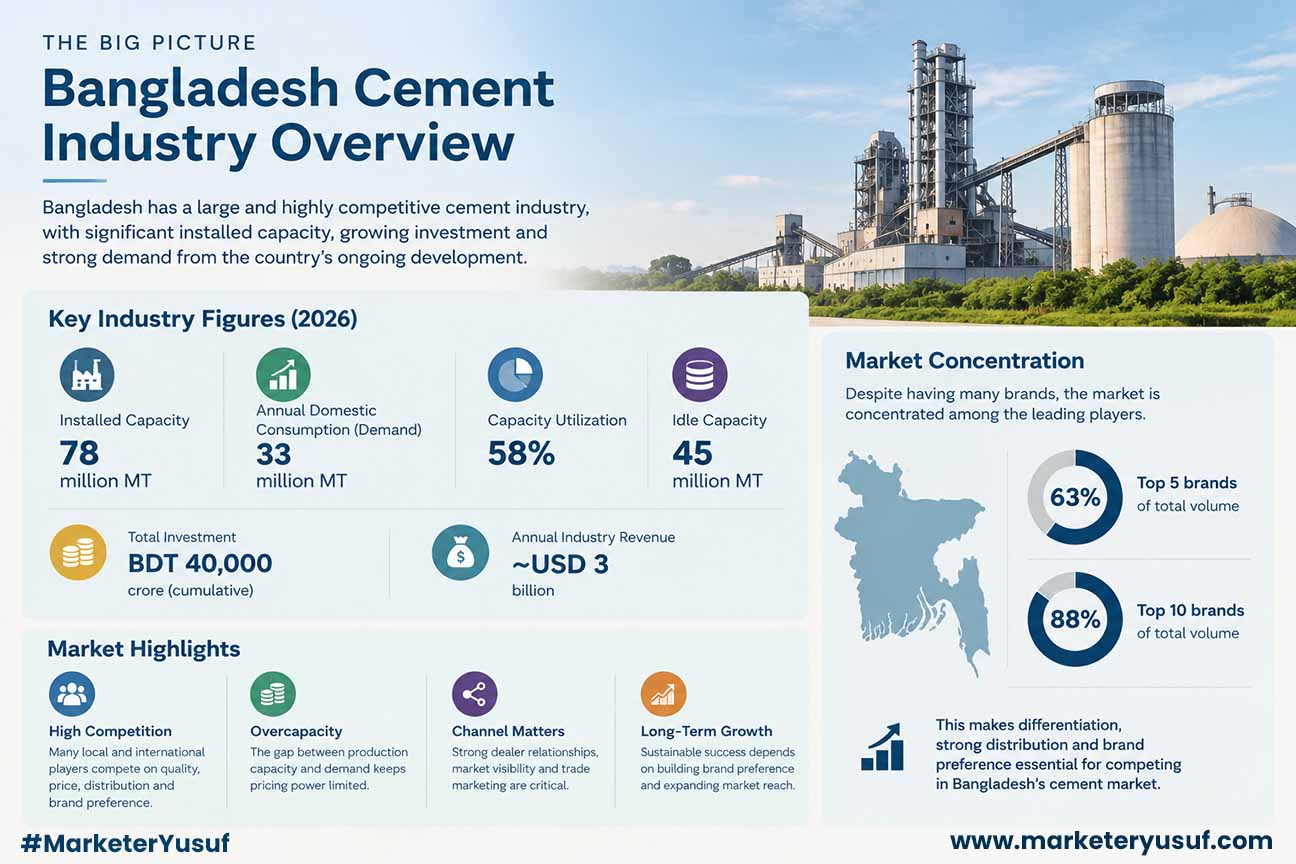
Bangladesh Cement Industry Overview
A Highly Competitive Market
The gap between capacity and demand makes competition intense. Brands compete through pricing, distribution, channel relationships, market visibility, trade marketing, and customer preference. With pricing power constrained by overcapacity, channel reach and brand preference become increasingly important.
Major Players in cement industry in Bangladesh
The market includes major brands such as
- Shah Cement
- Seven Rings Cement
- Fresh Cement
- Crown Cement
- Bashundhara Cement
- Premier Cement
- Akij Cement
- Anwar Cement
- Confidence Cement
- Tiger Cement
- Mir Cement
- Seven Horse Cement
- Metrocem cement
And international players including
- LafargeHolcim Bangladesh,
- Heidelberg Materials, and
- Insee Cement.
Bangladesh Market Concentration
Despite having many brands, the market is concentrated among leading players. The report estimates the top five brands at approximately 63% of volume and the top ten at around 88%.
This creates a clear strategic challenge: how can a cement brand become visible, trusted, preferred, and remembered in such a competitive market?
Read more, Brand Marketing Across Diverse Industries in Bangladesh: Lessons from My Practical Experience
Understanding Cement Brand Marketing
Brand marketing principles apply across industries, but cement has a more complex path from awareness to purchase. A cement brand may need to influence the end customer as well as engineers, contractors, masons, dealers, retailers, and other stakeholders.
Brand Marketing vs. Cement Brand Marketing
In many consumer categories, brand marketing focuses mainly on awareness, consideration, emotional connection, and purchase preference.
Cement brand marketing requires a broader approach:
Brand Building + Trade Marketing + Influencer Engagement + Distribution + Customer Communication
The objective is not simply to make people know the brand. It is to make the brand available, trusted, recommended, preferred, and ultimately purchased.
Why Branding Matters in Cement
When several brands communicate similar benefits such as strength, quality, and reliability, product claims alone may not create enough differentiation.
A strong cement brand helps build:
- Awareness
- Trust and credibility
- Preference
- Differentiation
- Channel loyalty
- Long-term brand equity
Product Differentiation vs. Brand Differentiation
Product differentiation is about what is different in the product-such as performance, technical characteristics, formulation, or application.
Brand differentiation is about how the market understands and values those differences.
A strong product provides the foundation; strong branding gives that product a distinctive meaning in the market.
Cement Buying Decision & Key Stakeholders
In cement brand marketing, the person who purchases the product is not always the person who recommends or specifies it.
Different stakeholders influence different parts of the decision:
| Stakeholder | Typical Influence |
| Individual Home Builder | Budget, brand awareness, family, dealer and professional recommendations |
| Real Estate Developer | Technical requirements, specifications, price, supply and procurement |
| Government | Specifications, tender, technical evaluation and procurement |
| Engineer | Technical evaluation and specification |
| Mason / Contractor | Practical experience, recommendation and site-level influence |
| Dealer / Retailer | Availability, price, commercial terms and final purchase |
The industry study describes the mason as an important brand-selector for individual home builders, the engineer as a project spec-setter, and the dealer as the last-mile seller.
Therefore, cement brand marketing cannot focus on one audience alone. It needs to address the entire ecosystem:
Engineer → Mason/Contractor → Dealer/Retailer → Customer/Project
Cement Customer Journey
A cement customer journey can be simplified into five stages:
Trigger → Awareness → Evaluation → Purchase → Loyalty
- Trigger: A construction need begins.
- Awareness: Advertising, OOH, digital media, family, word of mouth, and other touch points create brand awareness.
- Evaluation: Engineers, masons, product information, price, and previous experience influence consideration.
- Purchase: Dealer availability, price, credit, and recommendations influence the final choice.
- Loyalty: Product experience can influence future preference.
For an individual home builder, the journey can begin months before actual purchase. The industry outlook shows awareness forming the consideration set, followed by engineer and mason influence, dealer interaction, purchase, and performance-driven loyalty.
The marketing implication: build the brand before the customer reaches the point of purchase.
Cement Brand Positioning Strategy
In a crowded market, visibility alone is not enough. A cement brand needs a clear reason to be chosen.
A practical positioning process is:
- Market Research
Understand the market, customers, competitors, and stakeholders. - Segmentation
Identify the audiences and markets the brand needs to serve. - Competitor Analysis
Understand what competing brands communicate and where gaps exist. - Differentiation
Identify a meaningful and own able point of difference. - Brand Promise
Define the value the brand consistently promises. - Reason to Believe
Support the promise with credible product, technical, operational, or customer evidence.
The goal is to move beyond generic category claims and create a distinct, relevant, and credible position.
Cement Brand Identity Strategy
Positioning becomes visible through brand identity.
For a cement brand, the identity system includes:
Logo + Colour + Cement Bag + Visual Language + Tone of Voice + Brand Guidelines
The cement bag is particularly important because it is a physical brand touchpoint at dealers, retailers, and construction sites.
The same identity should be recognizable across cement bags, billboards, shop branding, websites, social media, brochures, POSM, and sales materials.
Consistency turns individual marketing materials into one recognizable brand.
Cement Brand Communication Strategy
A cement brand does not need to communicate the same message in every campaign. Instead, different communication roles can work together under one brand position.
- Functional: What does the product offer?
- Technical: What evidence supports its performance?
- Emotional: What does the brand stand for?
- Educational: What useful construction knowledge can it provide?
- Brand Storytelling: What larger idea connects the brand with its audience?
The objective is simple: Different messages, one consistent brand.
ATL Marketing Strategy
ATL marketing remains important for building mass awareness and brand recall.
- TVC
- Useful for communicating the brand idea and reaching a broad audience.
- Can support brand, product, corporate, technical, and campaign communication.
- OOH & Billboard
- Important for maintaining visibility across key markets and construction-heavy locations.
- Brand Recall
- The objective is not simply reach. Consistent and repeated exposure helps keep the brand mentally available when the purchase decision eventually arrives.
The industry outlook identifies TVC, print, radio, OOH, billboards, High-wall/ low wall paint and other visibility activities among the major promotional tools used in the category.
Trade Marketing Strategy
A cement brand cannot be built only through advertising. The product also needs to be available, visible, and supported through the channel.
A typical channel structure is:
Distributor → Dealer/Sub-Dealer → Retailer → Customer
Trade marketing can include:
- Dealer incentives
- Retailer support
- Shop branding and POSM
- Dealer conferences and recognition
- Distributor relationship management
- Channel loyalty programs
- Sales promotions
The 2026 industry outlook maps a three-tier channel system covering dealers, sub-dealers, and retail outlets, with retail shops serving as important last-mile points for individual home builders and small contractors.
Influencer Marketing
Cement is influenced heavily at the construction site. Masons, contractors, and engineers can recommend, specify, or influence which brand is used.
Effective activities include:
- Mason Engagement: Mason meets, loyalty programs, recognition, training, and product engagement.
- Mistri Sammelan: Direct gatherings that combine relationship building, communication, and engagement.
- Contractor Engagement: Contractor meets, site visits, and professional relationship building.
- Engineer Engagement: Technical seminars, product information, testing, and professional programs.
The objective is to build trust and advocacy, not simply event attendance. Industry examples include mason rallies, engineer meets, technical seminars, training, loyalty programs, and site-quality services.
BTL & Field Activation
BTL creates direct interaction with the people who influence purchase.
- Dealer Meet: Channel relationship
- Mason Meet: Familiarity and advocacy
- Roadshow: Local awareness
- Site Activation: Real construction engagement
- Community/Field Program: Local relationship building
These activities can make the brand more tangible and locally relevant.
Digital Marketing Strategy
Digital marketing allows cement brands to remain connected beyond traditional advertising.
A practical digital ecosystem can include:
- Website: Brand, product, technical information and enquiries
- SEO: Capture relevant construction-related searches
- Facebook: Awareness and engagement
- YouTube: Video, product and educational content
- LinkedIn: Corporate and B2B communication
- Google Ads: Search visibility and lead generation
- WhatsApp: Direct customer and dealer communication
- Lead Generation: Convert digital interest into measurable enquiries
The industry outlook specifically identifies Facebook, YouTube, Google Search, WhatsApp dealer communication, influencer campaigns, and branded digital platforms as category activities.
Content Marketing Strategy
Cement brands should not use digital platforms only for product promotion. They can also become a source of useful construction knowledge and credible information.
A practical content mix:
| Content | Purpose |
| Brand Content | Build identity and meaning |
| Product Content | Explain relevant product benefits |
| Technical Education | Build professional credibility |
| Construction Tips | Provide practical value |
| Project Stories | Show real-world application |
| Trust & Proof | Support claims with evidence |
The goal is to move from selling cement through content to building trust through useful content.
Integrated Marketing Communication (IMC)
Cement marketing channels should not operate as separate activities. Integrated Marketing Communication connects them under one brand strategy.
- Brand Strategy
- ATL + Digital
- Trade + BTL
- Stakeholder Engagement
- Sales Alignment
ATL can build awareness, digital can create engagement, trade marketing can support channel relationships, and stakeholder programs can influence recommendation.
The key is not to communicate more. It is to communicate consistently across every relevant touchpoint.
Common Cement Brand Marketing Mistakes in Bangladesh
Several mistakes can weaken cement brand building:
- Price-Focused Marketing
Continuous price competition can make brand differentiation difficult. - Generic Positioning
Repeating common category claims makes the brand harder to distinguish. - Budget Limitation
Limited resources can make consistent brand building and market activation difficult. - Ignoring Channels & Influencers
Dealers, retailers, masons, contractors, and engineers can influence brand choice. - Weak Digital Presence
A limited digital presence reduces opportunities for education, engagement, and lead generation. - Inconsistent Identity
Different visual styles and messages can weaken recognition. - Short-Term Focus
Focusing only on immediate sales can weaken long-term brand equity.
A sustainable strategy needs to balance short-term sales with long-term brand building.
Practical Cement Brand Marketing Framework
A strong cement brand is built through a connected process:
- Research
Understand the market, customer, competition, and stakeholders. - Segmentation
Define the audiences and markets. - Positioning
Establish what the brand should stand for. - Identity
Translate the position into a recognizable identity. - Communication
Develop the core brand message. - ATL + Digital + Trade + Influencer + BTL
Activate across relevant channels. - Sales Alignment
Connect marketing with sales and distribution. - Measurement
Track brand, marketing, channel, and business performance. - Optimization
Improve the strategy based on results and insights.
In short:
Research → Segmentation → Positioning → Identity → Communication → ATL → Digital → Trade → Influencer → BTL → Sales → Measurement → Optimization
Real-World Lessons from Cement Brand Marketing
With 13 years of experience in Brand, Marketing and Communication, including around 7 years in the cement and building materials industry in Bangladesh, my biggest learning is that cement brand building has very few shortcuts. In such a competitive market, consistent branding, communication, channel engagement, and strong market presence are essential for sustainable growth.
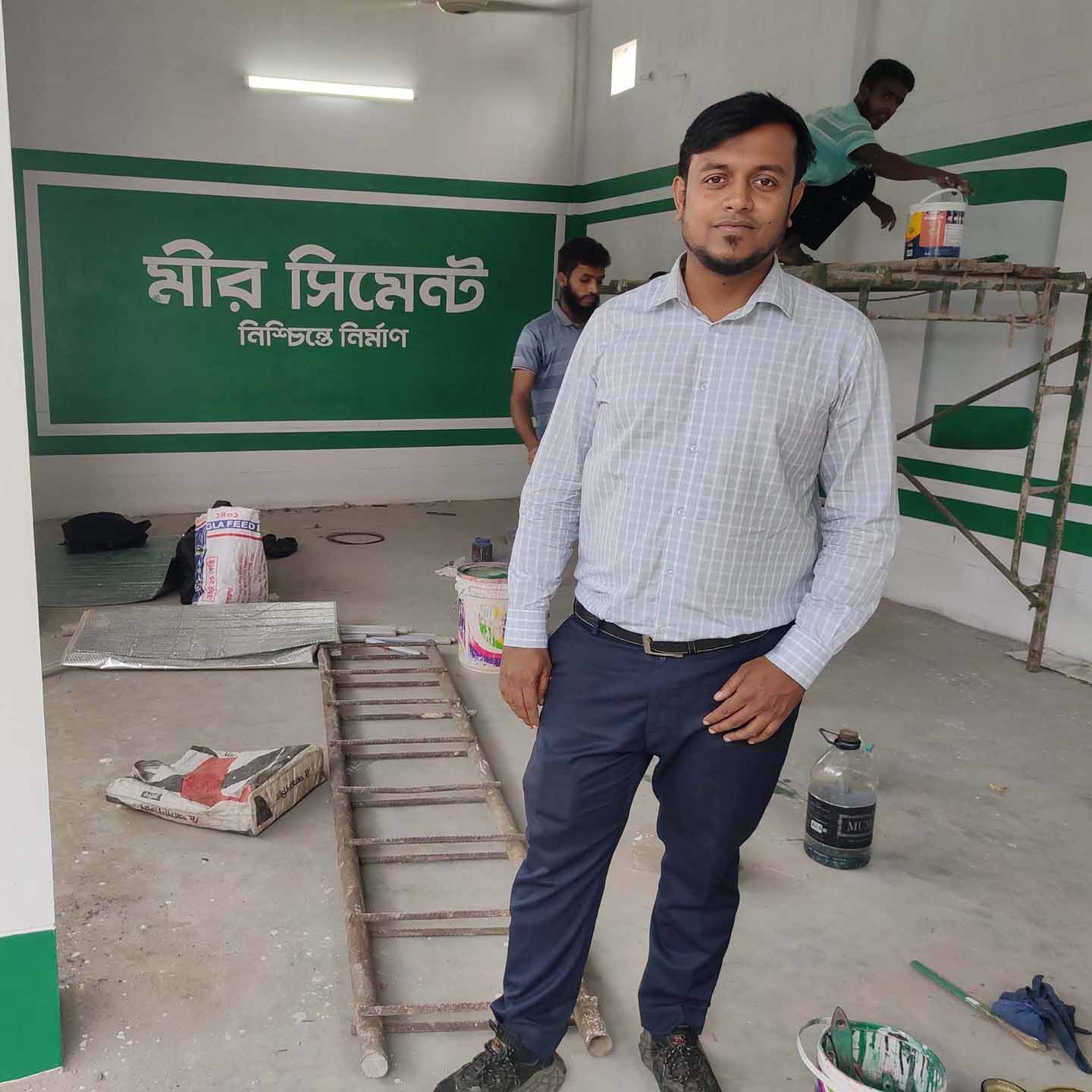
During my time with Mir Cement, I worked extensively on dealer and retailer engagement, including annual dealer conferences, 1,500+ shop branding, and monthly, quarterly, and yearly engagement, incentive, and loyalty activities. I also worked on extensive outdoor branding, including billboards, neon signs, high-wall and low-wall branding, signboards, transport branding, and other outdoor touchpoints.
Another important learning was the influence of masons, contractors, and engineers. Similar to how doctors influence medicine selection, these stakeholders can influence cement selection through recommendation and specification. I therefore worked on different mason and engineer engagement programs to strengthen relationships and local market presence.
One campaign that stands out was “Nishchinte Nirman” at Mir Cement. While many competitors were communicating around individual benefits such as strength and durability, we developed a broader brand idea that brought multiple expectations together under one thought. The campaign resulted in a reported 350% increase in sales. This experience reinforced my belief that strong positioning, market visibility, channel engagement, and sales performance can work together when consistently executed.
Future of Cement Brand Marketing in Bangladesh
The future of cement brand marketing will increasingly connect traditional marketing with data, digital platforms, CRM, technical content, sustainability, and regional execution.
- Data-driven marketing can help brands understand customer, channel, campaign, and market performance.
- Digital transformation and CRM can create more structured customer and channel relationships while improving lead management.
- Technical content can help brands build credibility with engineers, contractors, and other professional stakeholders.
- Sustainability can create opportunities for credible communication around responsible production, efficiency, and environmental initiatives.
- Regional marketing can help brands adapt campaigns and channel activities to local market realities.
Ultimately, the direction is toward integrated marketing, where brand strategy, ATL, digital, trade, BTL, stakeholder engagement, and sales work together rather than as isolated activities.
Conclusion
Building a strong cement brand in Bangladesh requires more than a good product or a large advertising budget. It requires a clear understanding of the market, the people who influence purchase decisions, the channels that deliver the product, and the communication that builds preference.
The strategic foundation can be summarized simply:
Strong Cement Brand = Product + Positioning + People + Channel + Communication + Consistency
When these elements work together, cement marketing can move beyond short-term promotion and contribute to long-term brand preference, customer trust, and business growth.
The goal is not simply to make a cement brand visible, but to make it meaningful, trusted, available, recommended, and remembered.
About the Author
Md. Yusuf, aka Marketer Yusuf, is the best brand strategist crafting research-backed branding and growth-driven campaigns. With 13+ years of experience spanning Jewellery, Cement, Real Estate, Agro, Healthcare, and Industrial sectors – including roles at Apan Jewellers, Mir Group of Companies, and Noapara Group – he helps businesses across Bangladesh build brands that connect, convert, and grow.
Connect with me through Social Media:
About Me

Md. Yusuf
Brand Strategist
Md. Yusuf aka Marketer Yusuf is the best brand strategist crafting research-backed branding and growth-driven campaigns.