

MD. Yusuf - Best Brand Consultant in Bangladesh
I’m Md. Yusuf, aka Marketer Yusuf - a Brand Strategist and Visual Storyteller. I help businesses grow through research-driven branding and marketing campaigns that connect, convert, and inspire.
By Md. Yusuf
Brand
September 7, 2026
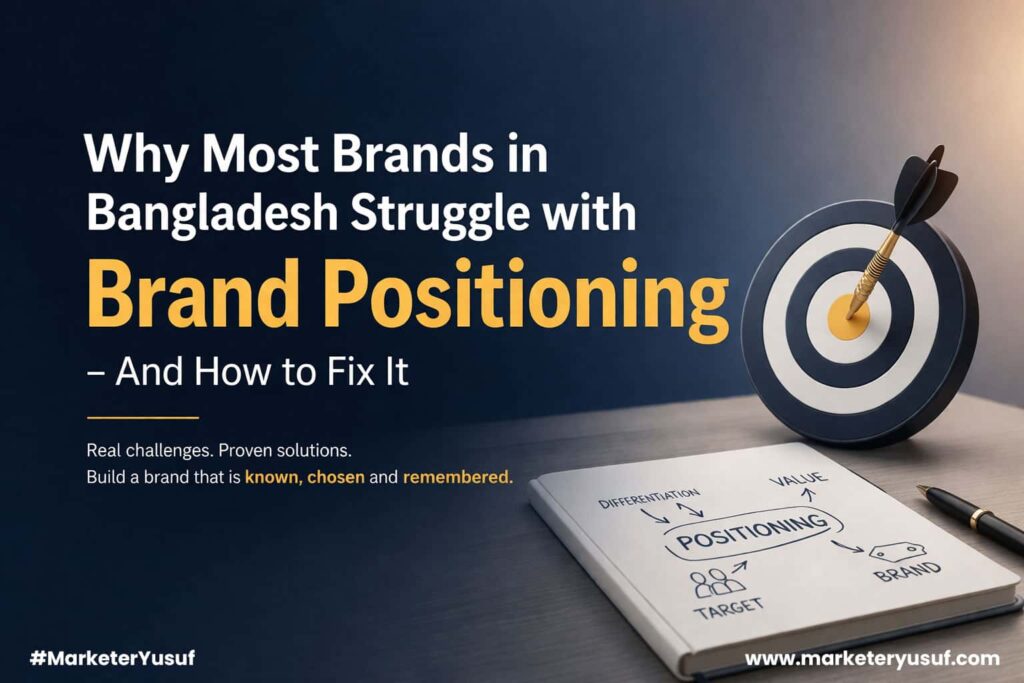
In my previous two blogs, I explored the foundational Practical Guide to Brand Positioning and the Strategic Frameworks needed to build a brand. But today, we need to have a difficult conversation: Why is it that despite having great products, so many Bangladeshi businesses fail to stand out?
Having worked with various local startups and established firms with over 12 years of experience in brand marketing, I’ve seen millions of branding budget wasted on marketing that simply doesn’t stick. In this blog, I’ll diagnose the most common mistakes and show you exactly how to fix brand positioning in Bangladesh.
The Reality of Brand Positioning in Bangladesh
In a market of over 180 million people, “visibility” is relatively easy to buy. You can run a massive campaign, plaster billboards across Dhaka, or hire influence to talk about your product. However, there is a massive difference between being known and being preferred.
The current state of brand positioning in Bangladesh is often reactive rather than strategic. Most local businesses operate in what I call “Survival Mode”- focusing on the next sale rather than the next decade. While our economy is growing rapidly, many brands are inadvertently building their houses on sand.
The “Facebook Boost” Trap
One of the most common issues I see is the over-reliance on digital “boosting.” In Bangladesh, many entrepreneurs mistake a high reach on Meta for a successful brand. But “Boosting” a post without a clear positioning framework is not a strategy; it’s simply a donation to a tech giant.
When your positioning is weak, you are forced to “pay for attention” every single time. A well-positioned brand, however, earns attention through relevance. If people don’t know exactly what you stand for, they will only buy from you when you are the cheapest or when your ad happens to pop up on their feed.
Noise vs. Signal
The Bangladeshi consumer is bombarded with thousands of marketing messages daily. From the streets of Motijheel to the scrolls of TikTok, every brand is shouting “Quality” and “Discount.” In this environment, a lack of clear positioning means your brand is just “noise.”
To win in 2026, you must move beyond the noise and become a “signal.” You don’t need to be the loudest; you need to be the most distinct. The reality is that if your brand disappeared tomorrow, would your customers actually miss you, or would they just move to the next cheapest option? If the answer is the latter, you have a positioning problem.
3 Common Reasons for Weak Brand Positioning
In my experience auditing local businesses, weak brand positioning isn’t usually caused by a lack of effort; it’s often the result of following the crowd. Here are the three most frequent “positioning killers” I encounter:
The “Me-Too” Marketing Trap
Many entrepreneurs in Bangladesh believe that if a competitor is successful with a campaign, copying it will lead to similar results. This “copy-paste” mentality is the death of differentiation. When you look, sound, and act like everyone else, you become invisible. To win in a crowded market, you shouldn’t try to be better than the leader; you should try to be different.
Discount Addiction over Value Creation
We have a massive “sale culture” in our local e-commerce and retail sectors. While a flash sale might give you a temporary revenue spike, it can destroy your long-term brand equity. If your customers only buy when there is a “Buy 1 Get 1” offer, you haven’t built a brand-you’ve built a bargain bin. Real positioning allows you to maintain healthy margins because the customer perceives a value that goes far beyond the price tag.
Targeting “Everyone” (The FOMO Problem)
The “Fear of Missing Out” (FOMO) is a real struggle for local business leaders. They worry that if they focus on a specific niche-such as “Premium organic skincare for busy professionals”-they will lose out on the mass market. The irony is that by trying to appeal to everyone, you end up resonating with no one. Strategic positioning requires the courage to say “No” to the wrong customers so you can become the “Only” choice for the right ones.
The Financial Cost of Poor Positioning
Every time a Bangladeshi business skips the positioning phase, they unknowingly increase their overhead. Here is how a poor strategy drains your bank account:
- Skyrocketing Customer Acquisition Cost (CAC): Without a specific space in the consumer’s mind, you have to “buy” that space every time you run an ad. This keeps your cost per lead high because there is no organic “pull.”
- The 20% YoY Reality Check: With Meta and Google ad costs in Bangladesh rising by nearly 15-20% annually, relying solely on “Ad Push” marketing is a recipe for shrinking margins.
- The “Leaky Bucket” Syndrome: You are pouring money into a business with no customer loyalty. You are perpetually stuck in a cycle of paying to acquire the same customer over and over again.
My Insight: Brand Positioning is the difference between an “Expense” and an “Investment.” A well-positioned brand builds equity that reduces your marketing costs over time.
How to Fix Brand Positioning in Bangladesh: A 4-Step Recovery
If you’ve realized your brand is currently “invisible,” here is my 4-step recovery plan to get back on track:
Step 1 – The Brand Audit (The Reality Check)
Conduct a “Brand Audit” by asking your existing customers: “What is the first thing that comes to mind when you think of our brand?” If their answer is “I don’t know” or “It’s cheap,” you have a positioning emergency. You must align what you think you are with what the market actually perceives.
Step 2 – Finding the “White Space”
In a crowded market, you win by standing in the “White Space”-the area your competitors are ignoring. Create a perceptual map. If all your competitors are positioned on “Price,” your white space might be “Premium Experience” or “Ultra-Niche Customization.”
Step 3 – Narrowing the Target (The Sacrifice)
As I often say, Positioning is a choice of what you are NOT. Instead of trying to serve all of Bangladesh, start by owning one specific segment.
- Example: Instead of being “A general clothing brand,” become “The best sustainable office wear for women in Dhaka.”
Step 4 – The Consistency Test
A brand is a promise kept. Every single touchpoint-your website, your packaging, your delivery speed, and even your “tea stall” reputation-must tell the same story 24/7.
Case Study: Moving from Generic to Iconic
To understand how to fix brand positioning, let’s look at a real-world scenario involving a local premium agro-business selling organic honey and ghee.
The “Before” (Generic Positioning): Originally, this brand positioned itself on “Purity” and “Low Price.” Their ads shouted: “100% Pure Honey – Best Price in Bangladesh!” * The Result: They were stuck in a price war. Customers kept asking for discounts, and Meta ad costs were eating all profits.
The “After” (Iconic Positioning): After a strategic audit, they shifted their focus to a specific “White Space”: The Shield against Food Adulteration.
- The Fix: They changed their messaging to “Safety for your Children.” Their new position was: “The only honey tested in three independent labs to ensure your child never consumes adulterated sugar.”
- The Outcome: They increased their prices by 30% and their sales actually grew. By moving from a “commodity” to a “solution,” they built a loyal community of parents who no longer cared about the competitor’s discount.
Conclusion: Positioning is a Long-Term Choice
Fixing your brand positioning is not a project you finish in a weekend; it is a fundamental shift in how you run your business. In a market as noisy as Bangladesh, clarity is your greatest competitive advantage.
When you stop trying to be everything to everyone, you finally become something to someone.
If your brand currently struggling with weak positioning, reach out to me at marketeryusuf.com to start your brand’s transformation today.
About Me

Md. Yusuf
Brand Strategist
Md. Yusuf aka Marketer Yusuf is the best brand strategist crafting research-backed branding and growth-driven campaigns.