Building Materials Industry


MD. Yusuf - Best Brand Consultant in Bangladesh
I’m Md. Yusuf, aka Marketer Yusuf - a Brand Strategist and Visual Storyteller. I help businesses grow through research-driven branding and marketing campaigns that connect, convert, and inspire.

By Md. Yusuf
Brand, Building Materials Industry
November 7, 2026
Building materials are not marketed like everyday consumer products. In Bangladesh, categories such as cement, steel, concrete blocks, paint, tiles, glass, sanitary ware, pipes, and electrical products involve different customers, technical requirements, influencers, distribution networks, and buying decisions.
After more than 13 years in Brand, Marketing & Communication hands-on experience with building materials, I have learned-as discussed in my broader article on Brand Marketing across Diverse Industries in Bangladesh-that there is no one-size-fits-all marketing formula. Building materials require a practical approach that connects brand strategy with technical proof, stakeholder relationships, trade marketing, distribution, and sales.
In this guide, I will share a practical framework for building materials brand marketing in Bangladesh-from understanding the market and decision-makers to positioning, product marketing, dealer engagement, influencer marketing, digital communication, measurement, and long-term brand building.
Understanding the Building Materials Industry in Bangladesh
The building materials industry is a broad and important part of Bangladesh’s construction ecosystem. It covers the products used to build, protect, finish, connect, and maintain residential, commercial, industrial, and infrastructure projects.
For marketers, however, building materials are not one homogeneous category. Cement, steel, paint, tiles, glass, sanitary ware, electrical products, pipes, and other construction inputs can have very different customers, decision-making processes, technical requirements, distribution structures, and marketing challenges.
What Are Building Materials?
Building materials are products used to construct, finish, protect, or support buildings and other structures.
They range from core construction inputs such as steel and cement to products such as paint, tiles, glass, sanitary ware, electrical products, pipes, roofing and boards.
In simple terms, if a product helps build, connect, protect, finish, or maintain a construction project, it can be considered part of the building materials industry.
Major Categories and brands of Building Materials
The Bangladesh building materials market includes a wide range of categories and brands. The presentation identifies the following major categories and representative brands:
| Category | Representative Brands in Bangladesh |
| Steel / Rebar | BSRM, AKS, KSRM, GPH Ispat, Anwar Ispat, Akij Ispat, Rahim Steel, Zsrm. |
| Cement | Shah Cement, Seven Ring, Crown, Fresh, Bashundhara, Anwar, Confidence, Mir. |
| Concrete Block | Mir, Concord, Hatim, Rupshi, BTI, CSRM, NDE, Niloy Green Block. |
| Paints & Coatings | Berger Paints, Asian, Nippon, Nerolac, Elite, Dulux. |
| Ceramics & Tiles | Akij, DBL, RAK, Mir, Star, Sheltec, Fresh. |
| Panels / Roofing & Boards | Super Board, Partex Star, Akij, Amber. |
| Glass | Nasir, AkijBashir Glass, PHP, Olila. |
| Sanitary ware | Kohler, Swish, RAK, Stella, Star. |
| Cable & Electrical | BRB, Super Star, Bizli, BBS, Partex, SSG, Transcom, SQ. |
| Pipe & Polymer | RFL, A1 Polymer, National Polymer, Lira, Akij. |
This diversity is important from a brand marketing perspective. A strategy that works for cement may not work in paint, steel, tiles, electrical products, or sanitary ware because the decision-makers, purchase journey, product considerations, and influence structure can change by category.
The Competitive Landscape of Bangladesh’s Building Materials Industry
Bangladesh’s building materials market includes established local brands, large business groups, and international brands across multiple categories. Competition therefore happens not only between products, but also for professional recommendation, dealer support, project specification, availability, trust, and brand preference.
A cement brand may depend heavily on dealer availability, contractor and mason relationships, and product trust. A steel brand may need strong technical credibility and engineer recommendations. A paint or finishing-material brand may have to influence homeowners, architects, retailers, and developers.
So there is no single marketing formula for the entire building materials industry.
Before developing a strategy, marketers need to understand:
- Who buys the product?
- Who uses it?
- Who recommends it?
- Who specifies it?
- What technical factors matter?
- Where is it purchased?
- What creates trust?
- What makes the brand different?
This is why brand strength and market access need to work together.
Why the Industry Matters for Brand Marketers
Building materials marketing is important because the decision is often influenced by more than the final buyer. Architects, engineers, developers, contractors, dealers, retailers, masons, technicians, and homeowners can play different roles depending on the product and project.
For marketers, this creates four major priorities:
| Priority | What It Means |
| Credibility | Support product claims with performance, technical information, certification, and evidence. |
| Influence | Build relationships with the professionals and trade audiences who shape product decisions. |
| Market Access | Ensure the product is available through the right dealers and channels. |
| Consistency | Maintain a clear brand experience across communication, trade, digital, packaging, and sales touch points. |
The opportunity is therefore bigger than advertising. A strong building materials brand needs to become known, trusted, recommended, specified, available, and preferred.
Why Building Materials Marketing Is Different from FMCG Marketing
Building materials may be sold as products, but they are rarely bought like everyday consumer goods. The purchase is generally more planned, technical, project-related, and influenced by several people and channels.
| Building Materials | FMCG |
| Relatively high-value and infrequent | Frequent and everyday |
| Often project-driven | Often consumption-driven |
| Multiple influencers and decision-makers | Usually simpler purchase journey |
| Technical performance is important | Functional and emotional benefits often dominate |
| Longer, consultative decision process | Usually shorter purchase cycle |
| Dealer and channel relationships can be critical | Retail availability plays a different role |
| Trust, proof and professional recommendation matter strongly | Familiarity, convenience and emotional appeal can play a larger role |
What Makes the Buying Process Different?
A building materials purchase can involve research, comparison, technical evaluation, recommendation, specification, dealer consultation, and finally purchase.
The person who pays may not be the person who recommends the product. An engineer may influence technical selection, an architect may specify a material, a contractor may influence practical choice, and a dealer may influence availability and recommendation.
Therefore, marketing has to support the decision-making process-not just create awareness.
Why Distribution and Trust Matter
Availability can influence whether a brand actually gets chosen. A brand may create strong awareness, but if the product is unavailable through the relevant channel, the opportunity can move to another brand.
At the same time, trust often comes from a combination of product performance, professional recommendation, dealer confidence, technical information, and previous project experience.
This makes distribution and trust part of brand building, not merely sales functions.
Why Emotional Advertising Alone Is Not Enough
Emotional advertising can create attention and familiarity, but building materials often require more evidence before purchase.
A useful marketing journey is:
Attention → Information → Proof → Trust → Recommendation → Purchase
The objective is not simply to make a brand visible. It is to make the brand credible enough to consider and accessible enough to purchase.
Who Influences Building Materials Brand Decisions?
Building materials decisions involve different stakeholders, and their influence changes according to the product and project.
| Stakeholder | Typical Influence |
| Architects | Design suitability, material recommendation and specification |
| Engineers | Technical evaluation, performance and compliance |
| Developers | Project requirements, commercial considerations and selection |
| Contractors | Practical application and execution |
| Dealers & Distributors | Availability, recommendation and channel access |
| Retailers | Product visibility and customer recommendation |
| Masons & Technicians | Application experience and practical preference |
| Homeowners | Final preference, budget and perceived value |
The key insight is that influence is product-specific.
A structural product may depend more heavily on engineers and project specifications, while a finishing product may involve stronger influence from architects, homeowners, retailers, painters, or applicators.
Buyer vs User vs Influencer vs Specifier
These roles can overlap, but they are not necessarily the same.
- Buyer: Pays for or orders the product.
- User: Uses or applies the product.
- Influencer: Shapes the purchase decision.
- Specifier: Recommends or defines the product to be used.
Understanding these roles helps marketers decide who to target, what to communicate, and when to communicate it.
Understanding the Building Materials Customer Journey
The building materials customer journey is rarely a simple straight line. Customers may move between research, professional advice, product comparison, dealer consultation, and technical evaluation before making a decision.
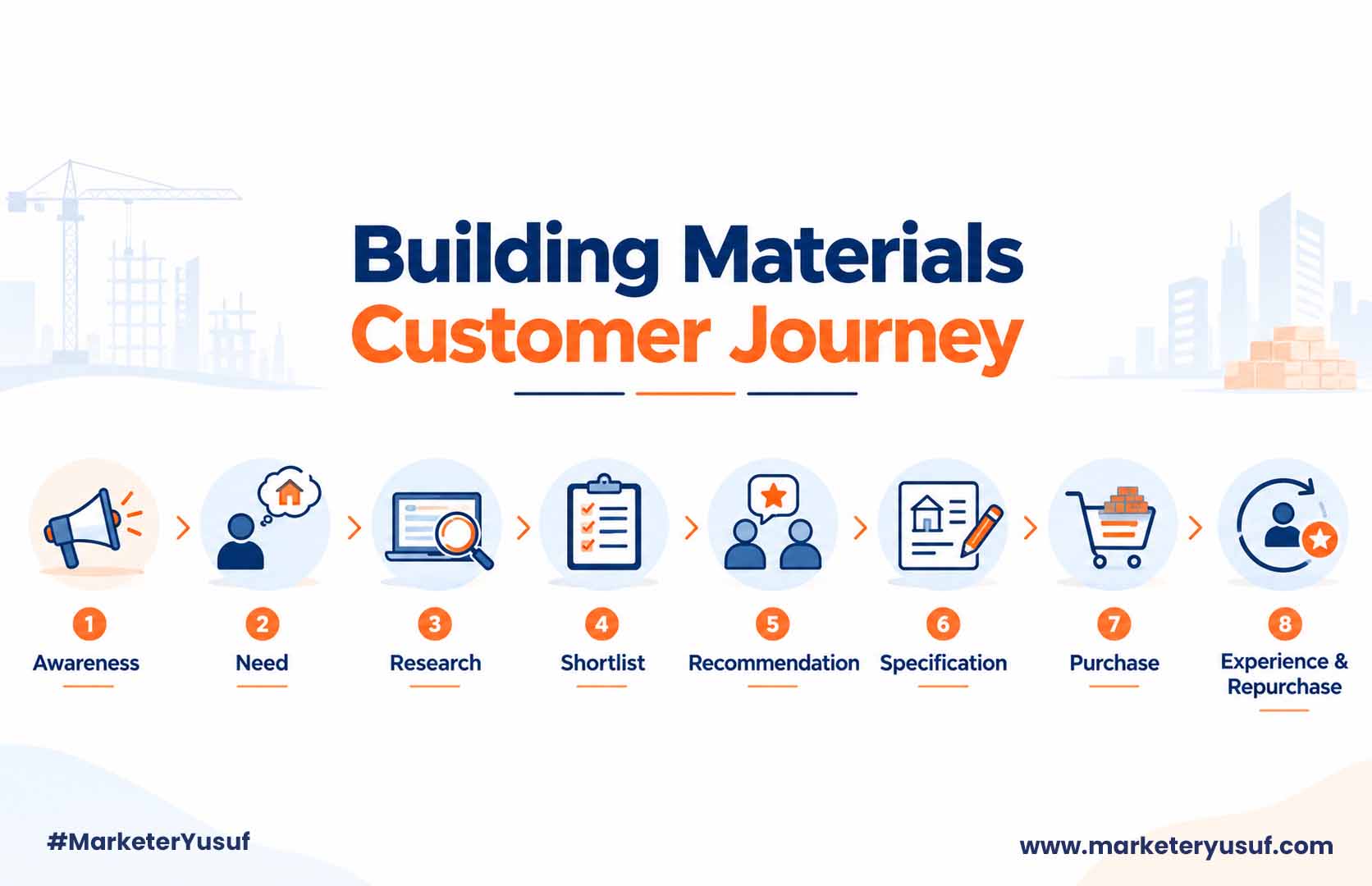
Awareness → Need Recognition → Research → Shortlist → Recommendation → Specification → Dealer/Channel → Purchase → Usage → Experience & Recommendation
Awareness
The audience first becomes aware of a brand through advertising, digital platforms, professionals, dealers, projects, or recommendations.
Need Recognition
A construction, renovation, or project requirement creates the need for a particular product or solution.
Research
Customers look for product information, specifications, applications, quality, availability, and alternatives.
Shortlisting
Several brands may enter consideration based on performance, reputation, recommendation, availability, and perceived value.
Recommendation
Architects, engineers, contractors, dealers, technicians, or other experienced stakeholders may influence the final choice.
Specification
For project-based purchases, the product may need to meet specific technical or application requirements before selection.
Dealer / Channel
Availability, local relationships, service, and recommendation can influence the final purchase.
Purchase
The customer selects the product based on the combination of need, trust, recommendation, availability, and value.
Usage and Experience
Actual product performance and application experience can influence future preference.
Repurchase and Recommendation
A positive experience can create repeat business, continued preference, and recommendations to others.
For brand marketers, this means communication should support the customer throughout the decision journey, not only at the point of purchase.
Building a Strong Brand Strategy for Building Materials
A strong building materials brand strategy begins with market understanding before communication begins.
A practical strategic process is:
| Strategic Step | Key Question |
| Market Research | What is happening in the category and market? |
| Stakeholder Segmentation | Who buys, uses, influences, or specifies the product? |
| Competitor Analysis | How are competing brands positioned and communicated? |
| Opportunity Identification | Where is there an unmet need or market gap? |
| Target Audience | Which audiences should the brand prioritize? |
| Value Proposition | What meaningful value does the brand offer? |
| Brand Positioning | What should the brand stand for? |
| Reason to Believe | What evidence makes the promise credible? |
The purpose is to move from “We sell this product” to “This is why our brand deserves consideration and preference.”
Brand Positioning Strategy for Building Materials
Brand Positioning is especially important in technical categories because many brands can offer products with similar functional descriptions.
A strong position gives the market a clear understanding of what the brand stands for, whom it serves, and why it is different.
Performance-Based Positioning
Focus on measurable performance where the claim can be demonstrated with credible evidence.
Quality and Reliability Positioning
Build around consistent quality, dependable performance, supply reliability, or service where these are meaningful differentiators.
Technical Expertise Positioning
Build authority through technical knowledge, professional support, product education, and credible information.
Value-Based Positioning
Communicate overall customer value rather than competing only on the lowest price.
Sustainability-Based Positioning
Where genuinely supported by the product and business practices, sustainability can become part of the brand proposition.
Application-Based Positioning
Position the brand around a particular construction application, project requirement, or customer problem.
Building a Differentiated Brand Position
A practical framework is:
Target → Need → Difference → Proof → Position
The most important element is Proof.
A differentiated claim without credible evidence remains just a claim. In building materials, the position should be supported by performance information, certification, project experience, demonstrations, testimonials, or other relevant evidence.
Product Marketing: From Features to Proof
Product marketing in building materials should answer a practical question:
Why should a customer or professional trust this product for the intended application?
From Features to Benefits
Technical features become more useful when customers understand what they mean in practical terms.
Instead of simply listing specifications, explain the relevant customer benefit and application.
Technical Proof and Certification
Technical specifications, durability information, compliance, certifications, standards, and performance data can provide the evidence behind a brand promise.
The information should be accurate, easy to understand, and relevant to the audience.
Demonstration, Projects and Testimonials
A product demonstration can show application and performance. Project references can demonstrate real-world use. Customer testimonials can provide experience-based confidence.
Together, these elements create a stronger communication system than promotional claims alone.
Proof Points, Not Pithy Slogans
This is one of the most important principles of building materials marketing.
The presentation emphasizes verifiable performance data, durability, compliance, technical education, and demonstrations as stronger foundations for communication than generic slogans.
In a technical category, the question is not only:
“What do we claim?”
It is:
“What can we prove?”
Trade Marketing and Dealer Strategy
For many building materials brands, the dealer network is where brand communication meets actual market access.
Dealer network activation as a crucial part of market reach, including BTL activities, trade schemes, joint promotional events, and specialized training for dealer sales forces.
Dealer Network and Distribution
A brand needs the right products to be available in the right markets through the right channel partners.
Distribution should therefore be considered part of the customer experience.
Trade Activation
Trade schemes, dealer programs, BTL activities, and local activations can encourage channel participation and strengthen market presence.
However, trade promotion should support long-term brand preference rather than become the only reason dealers or customers engage with the brand.
Dealer Visibility and Joint Promotion
Dealer branding, point-of-sale visibility, joint promotions, dealer events, and local activities can help maintain brand presence where purchase decisions happen.
Joint activity can also create a stronger connection between the manufacturer and channel partner.
Dealer Training and Loyalty
A dealer’s sales team may be responsible for explaining a product to customers. Training them on product benefits, applications, specifications, and key proof points can improve the quality of brand communication at the point of sale.
Dealer loyalty is built through more than incentives. It depends on business value, relationship, service, communication, availability, and mutual growth.
In building materials, the channel should not only sell the brand. It should be able to understand, support, recommend, and represent the brand.
Specifier and Influencer Marketing
In many building materials categories, the purchase decision starts before the customer reaches the dealer.
Architects, engineers, developers, contractors, and technical professionals can influence whether a product is considered, recommended, specified, or used.
Build Influence through Technical Value
Instead of approaching professionals only with promotional messages, brands can provide useful technical information, application guidance, product documentation, seminars, demonstrations, and project support.
Engage Different Stakeholders Differently
Architects may need design and application information.
Engineers may need specifications, performance data, standards, and compliance information.
Contractors and masons may care more about application, ease of use, productivity, and practical performance.
Developers may evaluate project requirements, reliability, commercial considerations, and long-term value.
The message should therefore change according to the stakeholder.
Demonstration and Professional Education
Technical seminars, workshops, webinars, CPD programs, and on-site demonstrations can help brands build credibility while educating professionals.
Project Specification
Specification marketing is particularly important because influence can happen before the actual purchase.
The objective is to make the brand considered, recommended, or specified at the right stage of the project.
ATL, BTL and Trade Activation Strategy
Building materials marketing requires a mix of broad visibility and deep market engagement.
The presentation highlights the importance of moving beyond mass-market communication toward hyper-local, trade-focused activities, including dealership events, trade shows, site activations, and builder workshops.
| Channel | Primary Role |
| ATL / Mass Media | Broad awareness and brand presence |
| Digital | Education, engagement, authority and leads |
| BTL / Field Activation | Direct engagement and product experience |
| Dealer Activation | Channel relationship and availability |
| Trade Shows | Industry visibility and professional networking |
| Site Activation | Application demonstration and project engagement |
| Builder / Contractor Events | Trade relationship and engagement |
The right question is not:
“Which marketing channel is best?”
It is:
“What behaviour do we want to influence, and which channel can influence it most effectively?”
Digital Marketing for Building Material Brands
Digital marketing can play a role far beyond social media posting. For building materials, it can become a platform for research, education, technical authority, trust building, and lead generation.
Website and SEO as Technical Authority
The website should make product information, applications, technical documents, certifications, projects, and contact options easy to find.
SEO should focus on useful searches around product categories, applications, technical questions, construction problems, comparisons, and solutions.
Social and Professional Platforms
Social media can support brand visibility, product education, project communication, application content, and ongoing engagement.
Professional platforms such as LinkedIn can support corporate reputation, B2B communication, industry expertise, and thought leadership.
Video and Technical Content
Video is particularly useful for product demonstrations, application guidance, technical explanations, project execution, and expert education.
Lead Generation, CRM and Sales Handover
Digital campaigns should connect interest with actual business opportunities.
A practical flow is:
Digital Interest → Inquiry → Qualification → Sales Handover → Follow-up → Opportunity → Conversion
The presentation also recommends using digital platforms for technical documents, major project case studies, and certifications to build authority and transparency.
Integrated Marketing Communication for Building Materials
A building materials brand may communicate through advertising, digital platforms, dealers, sales teams, packaging, technical events, field activities, and project communication.
The challenge is to make these different touchpoints work together.
One Brand, One Core Message
Campaign executions can change by channel, but the strategic brand idea should remain consistent.
Connect Awareness With Action
ATL and digital can create awareness and interest, while trade activities, professional engagement, dealers, and sales teams can move the audience closer to action.
Connect Marketing and Sales
Marketing should not operate separately from sales. Market feedback, customer questions, dealer insights, leads, and project opportunities should flow between the teams.
Build Consistency across Touchpoints
The brand should feel recognizably the same across packaging, dealer shops, technical materials, website, events, social media, and sales communication.
The goal is to build one connected brand experience rather than a collection of disconnected campaigns.
How to Measure Building Materials Brand Marketing Success
A building materials brand should measure marketing across the journey from awareness to market access and business results.
| Measurement Area | What to Measure |
| Brand Awareness | Is the brand known among relevant audiences? |
| Brand Consideration & Preference | Is it being considered and preferred? |
| Distribution Reach | Is the product available in target markets? |
| Project Specification Rate | Is the product being recommended or specified? |
| Dealer Engagement & Loyalty | Are channel partners actively supporting the brand? |
| Qualified Leads & Sales Conversion | Is marketing generating measurable business opportunities? |
Two indicators deserve particular attention in building materials:
Project Specification Rate shows whether the brand is entering project-level decisions.
Dealer Loyalty shows whether the channel continues to support the brand.
A brand can achieve high awareness and still struggle commercially if it is not specified, recommended, or available through the right channels.
So the better question is not only:
“How many people saw our campaign?”
It is:
“Did our marketing influence the people, channels, and decisions that shape demand?”
A Practical 6P Building Materials Brand Marketing Framework
After considering the market, stakeholders, customer journey, product, channel, and communication strategy, the complete approach can be summarised through a practical 6P Framework.
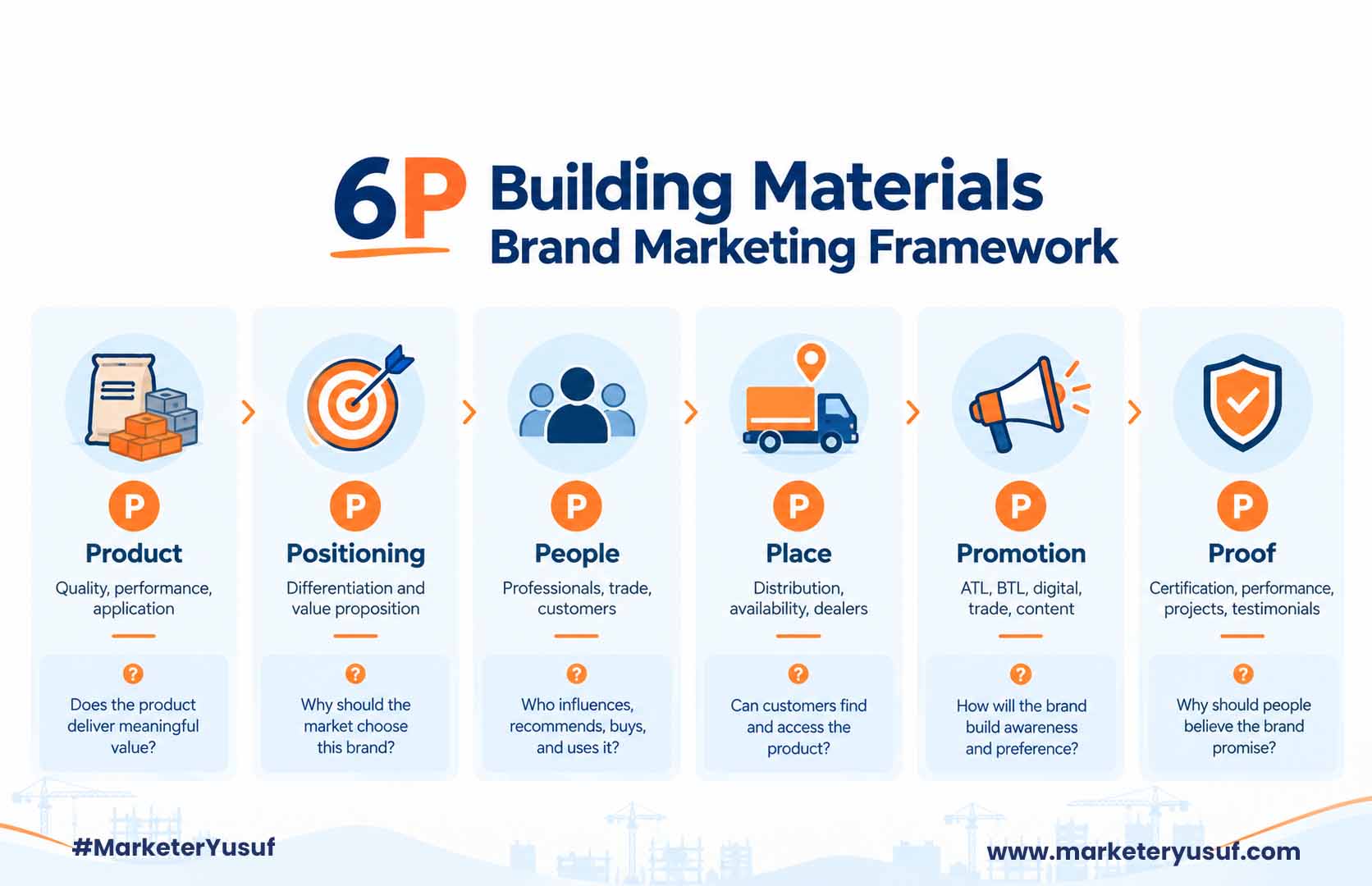
| P | Focus | Key Question |
| Product | Quality, performance, application | Does the product deliver meaningful value? |
| Positioning | Differentiation and value proposition | Why should the market choose this brand? |
| People | Professionals, trade, customers | Who influences, recommends, buys, and uses it? |
| Place | Distribution, availability, dealers | Can customers find and access the product? |
| Promotion | ATL, BTL, digital, trade, content | How will the brand build awareness and preference? |
| Proof | Certification, performance, projects, testimonials | Why should people believe the brand promise? |
These six elements are connected.
A strong product without positioning may struggle to stand out.
A strong position without proof may lack credibility.
Strong promotion without distribution may create demand that the business cannot capture.
And strong distribution without brand preference can leave the brand vulnerable to competitors.
The framework can therefore be expressed simply as:
Product + Positioning + People + Place + Promotion + Proof = A Strong Building Materials Brand
This is the central idea: building materials brand marketing is not a single communication activity. It is a connected system linking product credibility, stakeholder influence, market access, promotion, and proof.
What My Experience in the Building Materials Industry Has Taught Me
With 13+ years of experience in Brand, Marketing and Communication, I have spent around seven years working with building materials through my experience with Mir Group and Noapara Group. During this period, I had the opportunity to work with cement, concrete blocks, ready-mix concrete, tiles, sands, stones and other construction-related products.
One of my strongest learnings is that distribution is part of brand building. A brand can create strong awareness through ATL, BTL, and digital marketing, but if the product is not available at the right place, that awareness may not convert into business.
I have also seen how strongly architects, engineers, contractors, dealers, and masons can influence brand preference. The person who buys a product is not always the person who recommends or specifies it. This makes continuous stakeholder engagement an important part of building materials brand marketing.
Another important learning is that product proof builds trust. Technical specifications, certifications, project references, demonstrations, and customer testimonials can give customers and professionals reasons to believe a brand promise.
Perhaps my biggest learning is that there is no shortcut to building a strong brand in this industry. Building materials require long-term consistency across brand awareness, influencer engagement, trade marketing, ATL, BTL, digital communication, distribution, and sales support.
Brand and sales also need to work together. Marketing creates awareness and market demand, while sales and distribution help convert that demand into business. At the same time, sales teams provide valuable market feedback that can improve marketing decisions.
Most importantly, consistency matters. A customer may purchase certain building materials only once or a few times, while dealers, retailers, engineers, contractors, and other stakeholders continuously influence the market. If a brand stops communicating and building relationships, competitors can occupy that space.

After working across building materials for around seven years, my experience has taught me that sustainable brand success comes from product credibility, stakeholder relationships, distribution strength, sales alignment, and consistent brand building over time—not from a single campaign or short-term visibility.
Conclusion
Building a strong building materials brand requires much more than advertising.
The industry operates through a complex ecosystem of products, professionals, influencers, dealers, distributors, retailers, contractors, and end customers. Different products require different combinations of technical credibility, professional influence, distribution strength, and communication.
That is why a strong building materials brand needs:
Product Credibility
Clear Positioning
Technical Authority
Stakeholder Relationships
Dealer Strength
Integrated Communication
Consistent Brand Experience
The objective is not simply to make a brand visible.
It is to make the brand credible enough to trust, relevant enough to consider, strong enough to recommend, available enough to purchase, and valuable enough to choose.
My experience in this industry has reinforced one simple principle:
There is no shortcut to building a strong building materials brand.
Long-term success comes from understanding the market, engaging the right stakeholders, proving product value, strengthening distribution, supporting sales, and maintaining consistency across the entire brand experience.
In building materials, brand success is built over time—not created by a single campaign.
About the Author
Md. Yusuf, aka Marketer Yusuf, is the best brand strategist crafting research-backed branding and growth-driven campaigns. With 13+ years of experience spanning Jewellery, Cement, Real Estate, Agro, Healthcare, and Industrial sectors – including roles at Apan Jewellers, Mir Group of Companies, and Noapara Group – he helps businesses across Bangladesh build brands that connect, convert, and grow.
Connect with me through Social Media:
About Me

Md. Yusuf
Brand Strategist
Md. Yusuf aka Marketer Yusuf is the best brand strategist crafting research-backed branding and growth-driven campaigns.